Voice Security Consulting

Cybersecurity frameworks weren’t designed for real-time communications. Quobis bridges the gap.

a strategic discipline

Voice security is part of cybersecurity. But it needs its own rules.

Unlike many IT environments, attacks on voice networks affect services that must remain available, trusted and operational in real time. That makes security consulting for voice networks a strategic discipline: not only to identify risks, but to define how communications security should evolve across technology, governance, operations and compliance.

Quobis provides specialized consulting for operators, service providers, enterprises and public organizations that depend on secure, resilient and high-quality voice services.

We help organizations design security strategies, prioritize investments, strengthen governance and align real-time communications with broader cybersecurity and regulatory objectives.
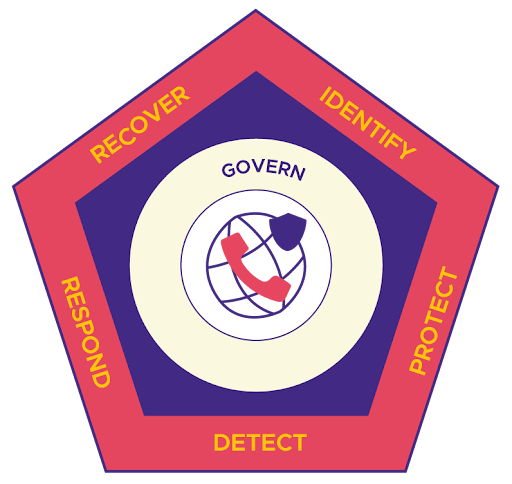
NIST Cybersecurity Framework 2.0

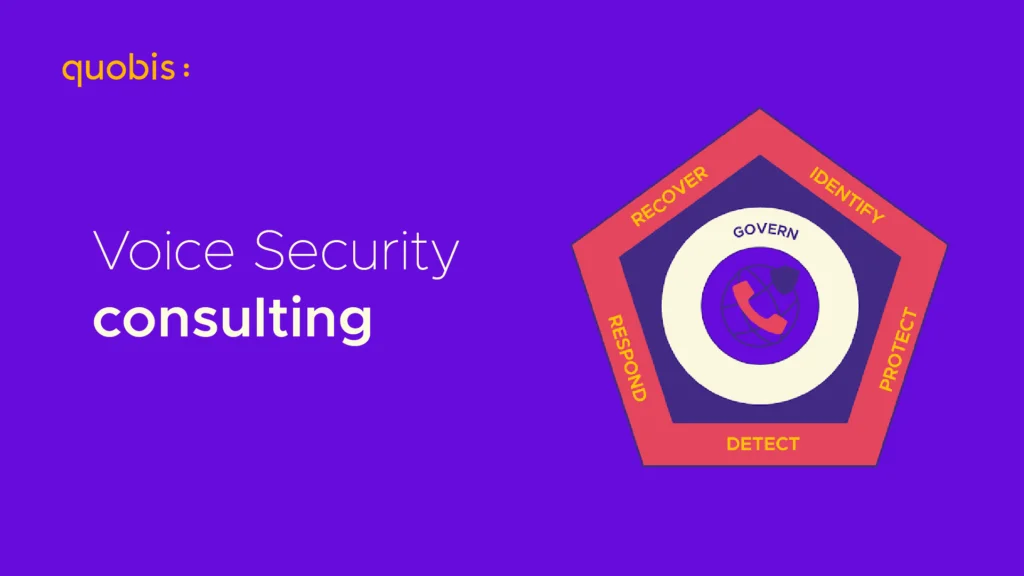
Built on NIST CSF 2.0. Extended for voice.

Standard cybersecurity frameworks address confidentiality, integrity and availability in general terms. But real-time communications demand specific treatment that generic frameworks don’t provide. The Quobis Voice Security Framework takes NIST CSF 2.0 as its foundation and extends it with two dimensions that are critical in voice environments: Availability and QoS.

The Quobis Voice Security Framework integrates Availability and QoS into every phase — from governance decisions to detection thresholds and recovery targets.

In voice, a brief interruption already constitutes a service incident. NIS2 requires reporting within 24 hours. Denial of service, hardware failures or volumetric attacks have an immediate, measurable impact on users. Availability isn’t just an infrastructure concern — it’s the primary indicator of service security for real-time communications.

In telecommunications, QoS is a component of effective availability. Latency, jitter, packet loss and bandwidth degradation are not just performance metrics — they are security-relevant conditions. And the implementation of security controls (encryption, inspection, filtering) can itself degrade QoS. Managing this trade-off is unique to voice environments and absent from generic IT security frameworks.

methodology

The Quobis Voice Security Framework

Quobis applies a structured consulting methodology aligned with leading cybersecurity standards and regulatory references, including NIST CSF 2.0, ISO 27001, NIS2 and DORA. The framework adapts those principles to the operational reality of real-time voice, SIP and communications environments, where security decisions must protect trust, availability and service quality in seconds.

Each consulting project can cover the framework end to end or focus on specific phases depending on the organization’s maturity, risk context and strategic priorities.

Govern

Integrating voice security into enterprise risk strategy

  • Risk management aligned with board-level tolerance
  • Supply chain governance across carriers, vendors and platforms
  • Policy design for NIS2, DORA and sector-specific regulation
  • Availability SLAs, QoS governance criteria and reporting obligations

Identify

Knowing what you have and what is at risk.

  • Asset mapping for voice infrastructure: SBCs, gateways, SIP servers, endpoints, carriers and cloud dependencies.
  • Risk evaluation specialized for real-time communications: SIP hijacking, toll fraud, call spoofing, eavesdropping and TDoS.
  • Caller identity trust assessment: verification frameworks, number authentication and branded calling strategies.
  • Supply chain risk analysis across carriers, vendors, platforms and interconnection points.
  • Continuous improvement cycle aligned with technological evolution, regulatory changes and lessons learned from incidents.

Protect

Strengthening foundations before threats arrive.

  • Identity management, authentication and access control: MFA, directory integration, least privilege and separation of functions across signaling, management and media planes.
  • SBC hardening, SIP protection, encryption with TLS/SRTP and secure configuration.
  • Data security for communications in transit, in use and at rest, balancing encryption strength with latency requirements.
  • Platform security: OS hardening, patching, secure virtualization and container configurations for communications infrastructure.
  • Technology infrastructure resilience: redundancy, load balancing and multi-carrier, multi-datacenter architectures.
  • Awareness and training tailored to specific roles: contact center agents, CISOs, telecom engineers and board members.

Detect

See what is happening in real time.

  • Continuous monitoring across physical, virtualized, cloud and hybrid communications environments.
  • QoS degradation as an early indicator of attack, abuse or infrastructure failure.
  • Anomaly detection, fraud detection and event correlation for voice-specific threats.
  • Alert prioritization based on service impact and business criticality

Respond

Act fast, contain the impact.

  • Incident response in seconds or minutes, not hours: identify, confirm and respond before QoS degradation becomes service failure.
  • Automated containment and mitigation: isolating nodes, blocking malicious traffic and applying emergency patches under pressure.
  • Coordinated escalation across technical teams, management, suppliers, carriers and regulatory authorities.
  • Response plan design, testing and continuous updating aligned with NIS2 notification deadlines: 24h early warning and 72h full report.
  • Incident simulations tailored to voice/VoIP attack scenarios (TDoS, toll fraud, eavesdropping)

Recover

Restore service, improve resilience.

  • Recovery validation with post-incident QoS verification: not just availability, but latency, jitter and packet loss back to target levels.
  • Rapid recovery across complex dependencies: backbone, cloud, DNS providers, carriers and manufacturers.
  • Backup integrity verification and rapid restoration of critical configurations, databases and recording volumes.
  • Service continuity management: failover to backup communications platforms when primary infrastructure fails.
  • Post-mortem analysis, KPI review and improvement recommendations to reduce future vulnerability.

Strategic goals we help achieve

The goal is to connect governance decisions with technical controls and operational readiness.

Define a voice security strategy

Strategic security model aligned with business, cyber risk and transformation objectives.

Governance and operating model

Roles, responsibilities, policies, escalation paths, supplier accountability and decision mechanisms.

Achieve regulatory compliance

Translation of NIS2, DORA and sector-specific requirements into controls, governance and evidence models.

Reduce fraud and build caller trust

Anti-spoofing, reputation protection, branded calling and fraud reduction strategy.

Technology and architecture roadmap

Security architecture for SIP, SBC, interconnection, encryption, monitoring, virtualization and resilience.

Resilience and continuity

Redundancy, recovery, availability and QoS protection for business-critical voice services.

Monitoring and detection

Operating models for visibility, alerting and incident detection across voice infrastructure.

Continuous improvement

Security maturity assessment, KPI review, lessons learned and evolution roadmap.

workflow

How consulting projects typically work

Step 1

Strategic framing

Understand business drivers, risk context, regulatory pressures and transformation objectives.

Step 2

Environment review

Analyze the communications ecosystem, stakeholders, dependencies and current control model.

Step 3

Decision support

Evaluate options, trade-offs and priorities across governance, architecture and operations.

Step 4

Target-state definition

Establish the future model for communications security, resilience and trust.

Step 5

Roadmap development

Define phased initiatives, sequencing, ownership and decision points.

Step 6

Advisory support

Accompany internal teams during implementation, procurement or program evolution as needed.

Concerned about sovereignty?

European voice security expertise

  • ISO/IEC 27001 certified.
  • Esquema Nacional de Seguridad (ENS) certified — fully compliant for EU public sector and NIS 2 standards.
  • Certified expertise with Oracle, Ribbon and other leading vendors.
  • Multi-vendor independence — no single-vendor lock-in.
  • Active participation in cybersecurity and regulatory think tanks.
  • Full operation under EU jurisdiction.

20 years of telecom engineering

Communications security is complicated. Protecting it with Quobis isn’t.

Build a stronger security strategy for real-time communications

Communications security is not just a technical matter. It affects trust, service availability, regulatory exposure, operational continuity and customer experience.

Explore Quobis Security & Trust solutions