

[Re]Trust in
Telecommunications
Principles for restoring trust in the global voice ecosystem.
Voice is the most human of all channels. Yet today, a call can fail before it even begins — not because of a technical fault, but because the person on the other end doesn’t trust who’s calling.
The current crisis of reachability is not a network failure. It is a rational act of self-defence. When receivers can no longer distinguish a legitimate call from an illegitimate one, suspicion becomes the default behaviour.
I
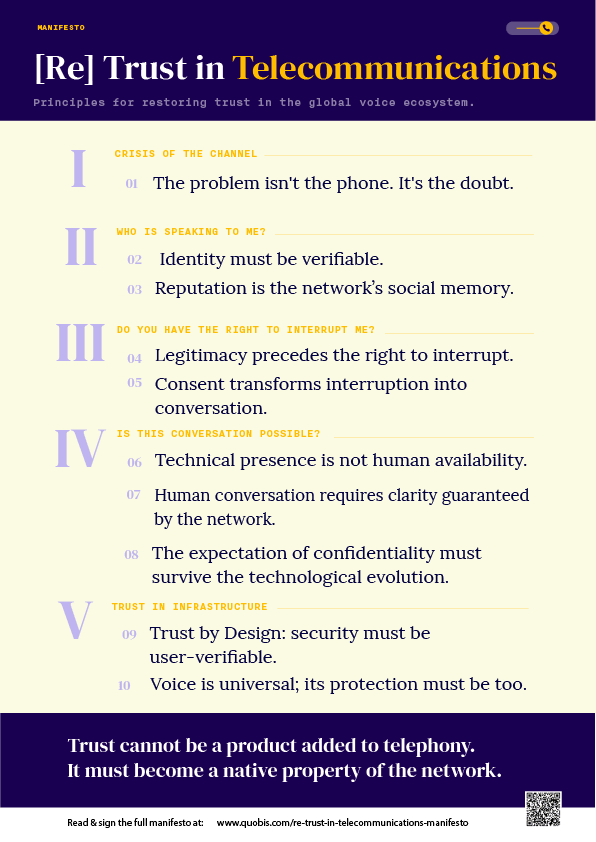
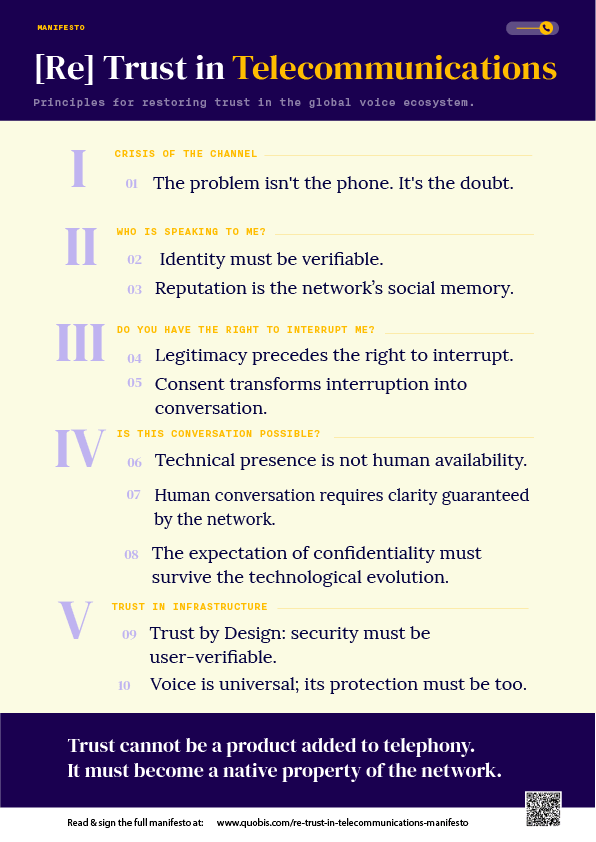
The problem isn’t the phone. It’s the doubt.
The problem isn’t the phone. It’s the doubt.
Even when a call is technically possible, it fails before it starts if the receiver’s psychological disposition is negative. The current contactability crisis is not a network failure — it is a rational act of self-defence. When receivers cannot distinguish a legitimate call from an illegitimate one, suspicion becomes the default behaviour.
Without verifiable trust signals, users perceive any unexpected communication as potentially hostile: they ignore unknown calls, block numbers, or delegate the decision to automatic filters. This imposes a high social cost — legitimate and important communications are lost: medical appointments, banking alerts, job offers.
The loss of trust in the voice channel does not stem from an inability to connect calls, but from the inability to guarantee who is calling, why they are calling, and whether the interruption deserves attention.
II
Identity and reputation
as foundations of trust.
Identity must be verifiable.
For a real conversation to exist, interlocutors need to recognise each other as subjects. In an environment dominated by anonymous profiles, bots, impersonations and AI-generated synthetic identities, certainty about who is speaking becomes the first filter for deciding whether a conversation is worth beginning.
Current telephony carries an identity model inherited from another era: a phone number as the sole identifier, with no verifiable guarantees of authenticity. Trust in the channel demands that identity can not only be displayed, but also independently verified.
Reputation is social memory applied to the network.
Reputation answers the channel’s fundamental question: how has this sender behaved over time? Trust in a communication does not arise solely from the technical authenticity of identity, but also from the history of interactions associated with it..
Reputation introduces memory into an environment where interactions are ephemeral. It must be proportional, transparent and reviewable. Trust cannot depend solely on automatic decisions that are inaccessible to those who participate in the communication.
III
Legitimacy precedes
the right to interrupt.
Legitimacy precedes the right to interrupt.
Unlike asynchronous media, a call demands immediate attention, intrudes into the receiver’s context and forces an immediate decision: answer or reject. Access to the voice channel cannot be treated as an unlimited right to capture attention.
Every interruption requires justification proportional to its urgency, relevance and context. When the purpose of a call is ambiguous, irrelevant or deliberately concealed, the interruption ceases to be communication and becomes intrusion. Infrastructure and signalling systems must provide the receiver with enough information to contextualise the call before answering.
Consent transforms interruption into conversation.
The existence of a technically accessible channel does not imply the right to use it without the receiver’s acceptance. Answering a call must always be a voluntary, informed and reversible act.
Consent cannot be reduced to a generic, opaque or permanent authorisation. It must be specific, contextual and revocable at any time. For that decision to be truly free, the user needs reliable information about who is calling, for what purpose, and under what expectations.
IV
Presence, clarity
and confidentiality.
Technical presence does not imply conversational availability.
Presence is a technical state of the network. It indicates that a device is connected, switched on and potentially reachable. Conversational availability incorporates human, physical and social dimensions that determine whether a conversation can and should take place.
The abuse of automated dialling systems and mass campaigns transforms the technical ubiquity of the network into a constant source of interruption. Trust in real-time communications demands recognition that the technical capacity to make contact does not equal conversational availability.
Human conversation requires clarity guaranteed by the network.
Voice communication occurs in real time and depends on the continuity of exchange to preserve its meaning. Unlike asynchronous communications, voice does not tolerate prolonged degradation or alterations that break the continuity of the interaction.
The network is not a neutral element within the conversational experience. By prioritising real-time voice traffic and preserving interaction quality, infrastructure acts as a technical guarantor of clarity and protects the human capacity to understand and be understood.
The expectation of confidentiality must survive the technological evolution of the voice channel.
Communications are intrinsically private whenever interlocutors use a closed channel — a point-to-point phone call, a video call or a private chat. The legitimate expectation of confidentiality is born at the moment the sender selects a channel designed to restrict access to third parties.
Technologies for mass transcription, automated monitoring and AI capable of synthesising or cloning voices radically alter the historical balance between conversation, memory and privacy. Trust in the voice channel demands that technological evolution preserves the legitimate expectation of confidentiality.
V
Security must be native,
not added later.
Trust by Design: security must be verifiable by the user.
If trust is only verifiable by the infrastructure, then it does not truly belong to the user. Attacking the channel is significantly easier than defending it. Automation, AI and the falling cost of technology make it possible to scale impersonations, fraud or mass disruptions with minimal resources.
Security cannot depend solely on reactive mechanisms added after the fact to infrastructure. Zero Trust architectures and native channel protection are the most effective way to preserve the integrity of communications without degrading the conversational experience. Trust in the channel can only be built when security guarantees not only exist, but can also be independently verified by all participants.
Voice is universal, its protection must be too.
Voice is the most universal human interface. The telephone network is one of the most extensive interoperable systems ever built. Regardless of country, operator, manufacturer or technology, billions of people can establish voice communications with each other through common standards and global interconnection.
The threats against the voice channel are also global. Fraud, identity theft, automated campaigns and other forms of cross-border crime exploit precisely the interconnected nature of the telephone ecosystem. The universality of voice requires protection mechanisms capable of operating in a coordinated manner across networks, jurisdictions and heterogeneous technologies.
Trust cannot be a product
added to telephony.
It must become a native property
of the network.
This manifesto is an open call to operators, technology providers, regulators and enterprises. Restoring trust in the voice channel requires collective action — from infrastructure to policy, from signalling to user experience.