Why the Public Administration Needs a Sovereign and Flexible Softphone
Quobis Softphone responds to the challenges of security, mobility and cost efficiency in the era of the digital workplace.
The digital transformation of the Public sector is no longer an option, it’s a mandate. Recent modernization plans and technical specifications have set a clear objective: to eliminate superfluous spending on hardware. At the same time, they guarantee real mobility for public employees.
However, the transition from traditional telephony to the cloud presents critical challenges. How can we modernize the workplace without handing over critical communications to foreign public clouds? How can we do this without wasting the investment in existing PBX systems?
This is where Quobis Softphone, based on the Quobis Communications Platform (WAC), positions itself as the strategic solution for the Administration.
We give you 5 key reasons or advantages of Quobis softphone for Public Administrations.
1. Technological Sovereignty and Transparency (Open Source):
Our technology is “developed on open source and standards.” Unlike public cloud UCaaS solutions (where data and voice often travel to servers in third countries), Quobis Softphone allows for flexible and sovereign deployment.
- Open Source DNA: Solution developed on a base of free software and open standards (WebRTC, SIP), which guarantees technological transparency and facilitates code security auditing. This eliminates the risk of hidden “backdoors” common in closed proprietary software.
- European Technology: 100% European development, free from interference and extraterritorial data regulations (such as the US Cloud Act) that affect large public cloud providers.
- Total Control: The Administration maintains ownership not only of the data, but also control over the logical infrastructure that processes it.
- Complete privacy: The solution can be deployed on-premises (in the organization’s own data centers) or in a certified private cloud. This ensures that the signaling and audio remain under the Administration’s control.
- Military Grade Security: The architecture supports end-to-end encryption in both signaling (SIP-TLS) and media flow (SRTP), meeting the most demanding security standards such as the National Security Scheme (ENS).
2. Goodbye to “Vendor Lock-in”: BYOC and BYOP Strategy
One of the biggest fears in modernization is becoming tied to a closed ecosystem that forces a complete infrastructure overhaul. Quobis breaks this dependency thanks to its agnostic interconnectivity capabilities:
- Keep your existing PBX (BYOP – Bring Your Own PBX): There’s no need to replace your current PBXs (Cisco, Unify, Alcatel, etc.). Quobis integrates seamlessly with them. In fact, it acts as a modernization layer that adds mobility without compromising your core phone system investment.
- Keep your carrier (BYOC – Bring Your Own Carrier): The administration can keep its current line contracts, numbers, and flat rates. Quobis acts as the advanced terminal, routing calls over existing SIP trunks. As a result, it avoids complex porting processes or call charges imposed by software providers.
3. The “Zero-Footprint” Revolution with WebRTC
Managing software across thousands of workstations is a logistical nightmare for IT departments. Quobis eliminates this problem at its root.
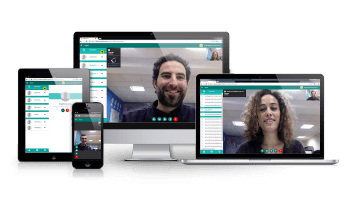
- Immediate Deployment: Because it’s based on the WebRTC standard, the softphone works directly from the web browser. This frees the IT team from installing, maintaining, and updating heavyweight clients on each employee’s computer.
- Real Mobility: The user carries their corporate extension in their pocket (iOS/Android mobile app) or on their laptop, enabling secure and transparent remote work. Furthermore, corporate identity is maintained: the employee calls from home, but the public sees the office’s landline number.
4. The best mobile experience is native
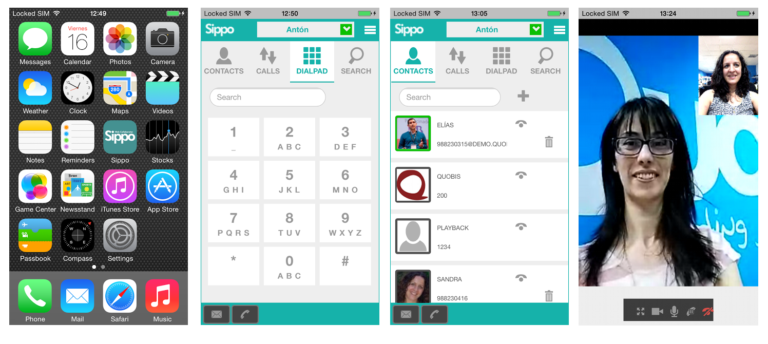
Although WebRTC can work in mobile browsers, the experience isn’t ideal for professional use (issues with notifications, battery drain, and background call management). That’s why Quobis Softphone offers native apps for Android and iOS.
- Push Notifications: Essential for the “softphone” to ring even if the application is closed or the mobile is locked.
- Push Notifications: Essential for the “softphone” to ring even if the application is closed or the mobile is locked.
- Security: The app creates a secure tunnel to the On-Premise server, allowing the employee to use their office number on their personal mobile (BYOD) without exposing their private number. In addition, this works without the need for a constantly active VPN.
5. Economic Efficiency: Elimination of the Physical Terminal
One of the basic principles of administrative efficiency is to eliminate assets that generate unnecessary recurring expenses. Maintaining thousands of physical telephone terminals on desks (many of them empty part of the time due to hybrid work) is a costly inefficiency.
- Hardware Savings (CapEx): Quobis allows you to replace the physical phone with a lightweight software client. This completely eliminates budget items for the purchase, replacement, and inventory management of physical devices.
- Maintenance Reduction (OpEx): By eliminating hardware, incidents due to breakage, cabling and wear disappear, freeing up IT resources for higher value tasks, and making maintenance costs much more predictable.
6. Frictionless migration and future-proof roadmap
Quobis softphone protects the investment made while offering a platform on which to evolve the digital administration roadmap
Unlike market solutions that require migrating all telephony to a new proprietary “cloud” (discarding the previous one), the Administration needs solutions that reuse the infrastructures already deployed. This protects the investment already made.
The solution allows you to keep your existing line and flat rate contracts, avoiding complex porting processes or contractual penalties.
By choosing Quobis Softphone, the Administration is not just buying a software phone; it is deploying a future-proof communications ecosystem. The same platform that serves civil servants today can enable new use cases tomorrow:
- Citizen Services: Video calls and click-to-call buttons integrated directly into the Electronic Offices to assist citizens while they browse.
- Integration with Microsoft Teams: If the organization uses Teams for collaboration, Quobis allows voice integration while maintaining sovereignty. Moreover, it helps avoid Microsoft’s expensive calling plans.
- APIs for Proprietary Apps: Integrate chat and secure voice within proprietary inspection, health or justice applications using SDKs.
7. Personalization and Corporate Identity
Unlike mass-market solutions such as Microsoft Teams or Zoom, where customization is very limited (just the logo and a background), Quobis allows the application to appear to be developed in-house by the administration itself. Therefore, this reinforces the message of technological sovereignty and its own service.
- Granular customization: Modification of logos, color palette (light/dark themes), corporate fonts, icons, and even ringtones
8. Flexible Deployment
Quobis Softphone can be deployed On Premise in any public or private infrastructure.
In a context where national security and data privacy are paramount, the government cannot afford to have voice communications travel over public clouds outside its jurisdiction. Quobis Softphone is designed to be deployed within the government’s own data centers. This ensures that users’ voice and data never leave the entity’s secure perimeter.
Modernizing the voice in Public Administration requires a delicate balance between innovation and control.
Quobis Softphone offers exactly that: the modern and flexible user experience that public employees demand, with the security, sovereignty, and cost efficiency that the institution requires.
It’s time to leave hardware behind and embrace secure, universal, and controlled corporate communication.