Metaverse and unified communications

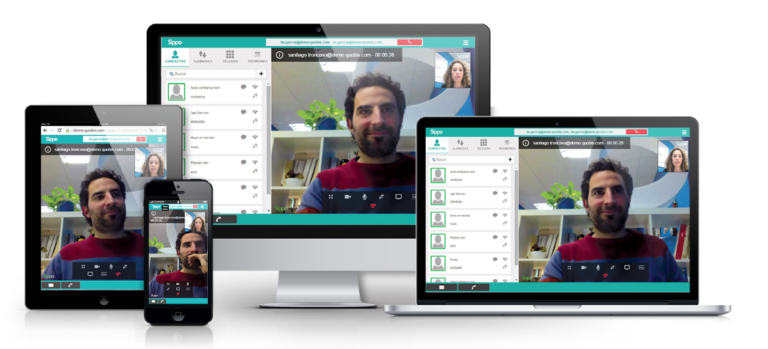
Quobis has a unified communications platform that is already used by business and more general customer profiles through telecommunications operators.

In a way, the technologies behind the metaverse, such as artificial intelligence, augmented reality, bots, webGL, etc. They have already been technologies present in the market in recent years and in which Quobis has participated in some way, even if it was before its standardization process. These proofs of concept or innovation projects have made it possible to analyze what the adaptation needs are so that it can be used to create specific metaverses or that it be a gateway to these metaverses.

WebRTC is a technology ahead of the metaverse but could be part of the set of technologies considered to enable it. WebRTC is natively implemented in the main browsers and supported in all types of devices, allowing access to the media (microphone, camera, screen, etc.), the establishment of multimedia sessions (videoconference, etc.) without having to install nothing on the device.

This flexibility is ideal so that it can also be used as a gateway to the metaverse, to avoid having to install heavy applications on the device (as is now the case with video games that expose virtual realities that we could consider metaverses).

Integration with the PSTN or switched telephone network  is one of the main points where Quobis can play a role, since it is part of Quobis’ DNA. Through the WebRTC to SIP gateway and the different ways of managing this interconnection, it is possible to make calls from the WebRTC environment and even delegate their registration to conventional telephone systems.

In this way, it is avoided to create an independent island of a metaverse from the rest of the communication systems. Adapting the platform as a gateway to the metaverse while maintaining interconnection with other communications platforms is a point of interest.
Similar Posts

  • Webinar about NFV and WebRTC by Quobis and Alcatel-Lucent

    In this 30 minutes talk, Alcatel-Lucent and CloudBand™ Ecosystem Program member Quobis® showcase Sippo™ — a resilient cloud-based unified communications (UC) application. The proof of concept shows Sippo linking into Alcatel-Lucent vIMS securely and automatically during the deployment process with CloudBand, and interconnecting Consumer & Business VoIP, Enterprise UC, and Voice over LTE (VoLTE) endpoints….

  • Five points to consider for real WebRTC deployments

    Original at http://blog.uppersideconferences.com/five-points-consider-real-webrtc-deployments/ There are nowadays lots of ongoing proof of concepts and field trials involving WebRTC, having some of them reached the production stage. In this post we are going to explore which problems arise when you move from the lab to a production environment. These are five points to take into account when…

  • Quobis joins WebRTC Expo Paris as partner sponsor

    Quobis, the leader in WebRTC applications for service providers and enterprise, today announced its participation as a Partner sponsor at the WebRTC Conference & Expo, 2014, to be held December 16th-18th, 2014, at the Hotel Marriott Rive Gauche, Paris. Hosted by Upperside Conferences for the 3rd consecutive year, the event is the largest global WebRTC…

  • Why the Public Administration Needs a Sovereign and Flexible Softphone

    Quobis Softphone responds to the challenges of security, mobility and cost efficiency in the era of the digital workplace. The digital transformation of the Public sector is no longer an option, it’s a mandate. Recent modernization plans and technical specifications have set a clear objective: to eliminate superfluous spending on hardware. At the same time,…

  • Artificial intelligence and real-time communications

    Although artificial intelligence-based systems have been in use for years, it seems that we are still in the early stages of implementation in the area of ​​unified communications. Technological evolution, together with market pressure to automate processes, will change the way in which we communicate, without the fact of interacting with machines being reviled by…

  • Enterprise video calling

     The future of communications is changing. In the last few years, instant messaging, live chat or webinars have become an everyday tool for millions of users. Because of this, having an omnichannel communication strategy is crucial to engage customers, build brand awareness and differentiate from competitors. Video represents an opportunity for companies to develop innovative…