Certificates and domains MS Teams SBCs

Certificates and domains in MS Teams Direct Routing

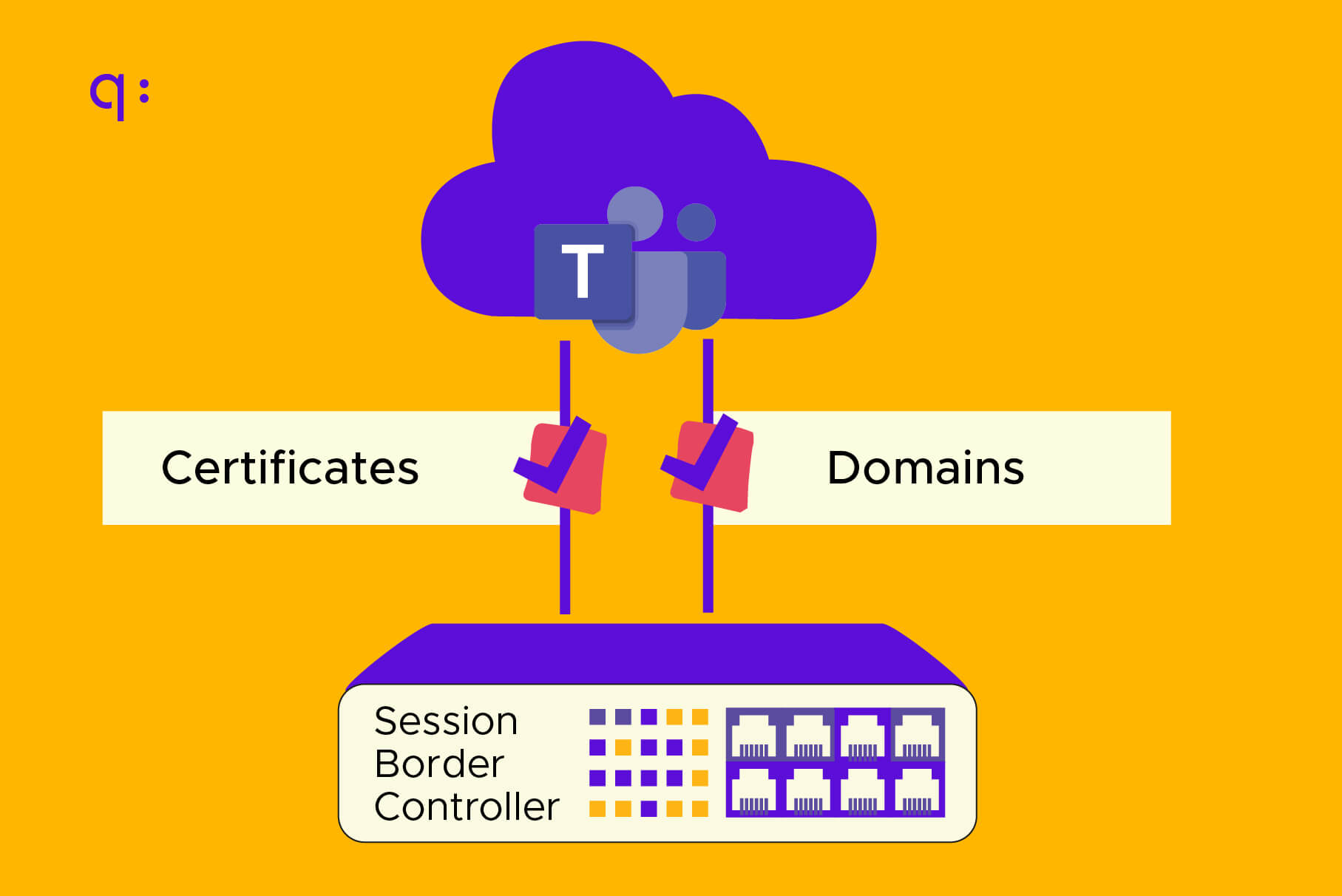
The first step will be to decide the domain name that we will assign to our certified SBC. For example:

sbc-for-msteams.name-company.com

Taking this domain into account, we generate the corresponding CSR (certificate signing request) in the SBC, including the FQDN and the company data (name, location, department, etc.) and we will request the generation of this certificate from the authorized CA.

As an alternative option, if we already have a wildcard (*.name-company.com), it can be imported into the SBC. As soon as we have the certificate on the SBC, encryption can be configured for the trunks.

In parallel, it will be necessary to create the DNS record corresponding to the domain of our SBC, pointing to the public IP of the SBC. Another important point is related to the connectivity between the MS Teams cloud instance and the SBC itself, which is typically linked to a client network deployment (although there is the possibility of using elements in a multi-tenant format such as the SBC as a Service offered by Quobis).

It is necessary to enable some rules in the intermediate elements (firewalls). For example, MS Teams uses port 5061 for SIP signaling and ports 3478-3481 and 49152-53247 for media traffic. In this link there is more information about these ports and policies. Quobis has been working for more than 15 years in integrations of customer switchboards and operator networks, using SBCs from different manufacturers and with more than 300 references.

Dozens of clients have counted on Quobis to manage the integration with MS Teams, so it can be the main ally to manage the implementation of MS Teams within their corporate network.


Similar Posts

  • Quobis partner of the year for Oracle Communications

    During the Oracle Industry Connect, Quobis was selected as Oracle Communication Partner of the Year for EMEA Enterprise considering: –          Commitment to Oracle Corporation –          New business Development  for Oracle based on our WebRTC solution –          Developed 30+ reusable and tested modules that enable partners/customers to quickly develop WebRTC client applications and integrating with Oracle WSC. –          Close cooperation with Quobis in various opportunities and countries.   In the…

  • Why the Public Administration Needs a Sovereign and Flexible Softphone

    Quobis Softphone responds to the challenges of security, mobility and cost efficiency in the era of the digital workplace. The digital transformation of the Public sector is no longer an option, it’s a mandate. Recent modernization plans and technical specifications have set a clear objective: to eliminate superfluous spending on hardware. At the same time,…

  • Latency and reliability in 5G networks

    Ultra-Reliable and Low-Latency Communications (URLLC) Ultra-Reliable and Low-Latency Communications (URLLC) have been one of the new application scenarios for mobile communication systems in the fifth generation ecosystem ( 5G). In 5G radio environments, objective indicators have been defined, such as not exceeding 1ms of latency. Before the arrival of 5G there was no real interest in improving…

  • Voice network monitoring: what metrics to use and for what?

    The monitoring of voice networks provides information that prevents attacks, prevents fraud, anticipates service drops and detects anomalous patterns. Although there are elements that support advanced metrics (even with other protocols such as MEGACO, MGP, ISUP, etc) in the SIP world they are usually measured in SBC and softswitches. These are the most common metrics: IETF RFC 6076 – first specific…

  • Quobis to demonstrate Sippo WAC at WebRTC conference Paris

    Vigo, Galicia, Spain, 24th November 2015.- Quobis, the leader in WebRTC applications for service providers and enterprise, today announced its participation as a Partner sponsor at the WebRTC Conference & Expo, 2015, to be held December 16th-18th, 2015, at the Novotel Convention & Wellness Paris Roissy CDG, Paris. Hosted by Upperside Conferences for the 4rd consecutive…

  • Five points to consider for real WebRTC deployments

    Original at http://blog.uppersideconferences.com/five-points-consider-real-webrtc-deployments/ There are nowadays lots of ongoing proof of concepts and field trials involving WebRTC, having some of them reached the production stage. In this post we are going to explore which problems arise when you move from the lab to a production environment. These are five points to take into account when…