Quobis announces Sippo version 2.3 in GA
Quobis®, the leader in WebRTC applications for enterprises and service providers, today announced a new release of Sippo WebRTC Application Controller and its associated use cases.
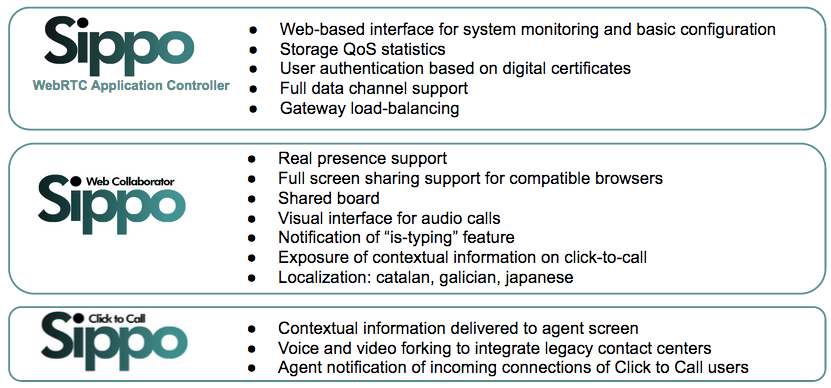
The version 2.3 of Sippo WebRTC Application Controller includes functionalities like user authentication based on digital certificates and fully datachannel support. This version provides a new web-based interface for system monitoring and basic configuration, that can be used by partners and customers to configure and adapt the behaviour of the different applications. In addition, scalability is one of the key points of this version, including the possibility to balance the WebRTC traffic to different WebRTC-to-SIP gateways, avoiding the need of dedicated load-balancers. Finally, the WAC leverages QoS reporting and statistics, using the information provided by the different WebRTC applications.
In addition, Sippo Web Collaborator and Sippo Click to Call applications provide a complete set of new functionalities (shared board, shared forms, etc.) that bring a real collaborative user experience. Contextual information is another new feature, allowing the other side to get information about the caller (location, type of browser, default language, etc.) that help to improve the quality of experience in different use cases. Meanwhile, the most popular feature is call forking, that makes possible to integrate a voice call with the existing infrastructure (i.e, ACD or legacy PBX in case of contact centers) while keeping video calls from browser to browser. This is the best way to add video and collaboration to existing audio platforms with minimal impact.
Ask your Quobis’ representative to get more information about these new features.
Additional Resources
- Understand the benefits of call forking here
- Read this whitepaper about the role of the WebRTC Application Controller here
- Connect with Quobis on Twitter
For more information please visit our website or send an email to yudani.riobo@quobis.com
About Quobis
Quobis is a leading european company in the delivery of carrier-class unified communication solutions with a special focus on security, interconnection and identity management for service providers and enterprises. Quobis is headquartered in Vigo (Spain) with partners throughout the world. . QUOBIS is well-known as one of the leaders in the standardization and deployment of WebRTC technology after being involved in the industry-firsts implementations and Proof of Concepts in more than 30 countries. More information can be found online at www.quobis.com.